If Your Roof
Unconditioned Storage or Shop Space
Winter heat loss matters more than summer cooling, and traffic scuffs should stay hidden.
Start WithBlack EPDM

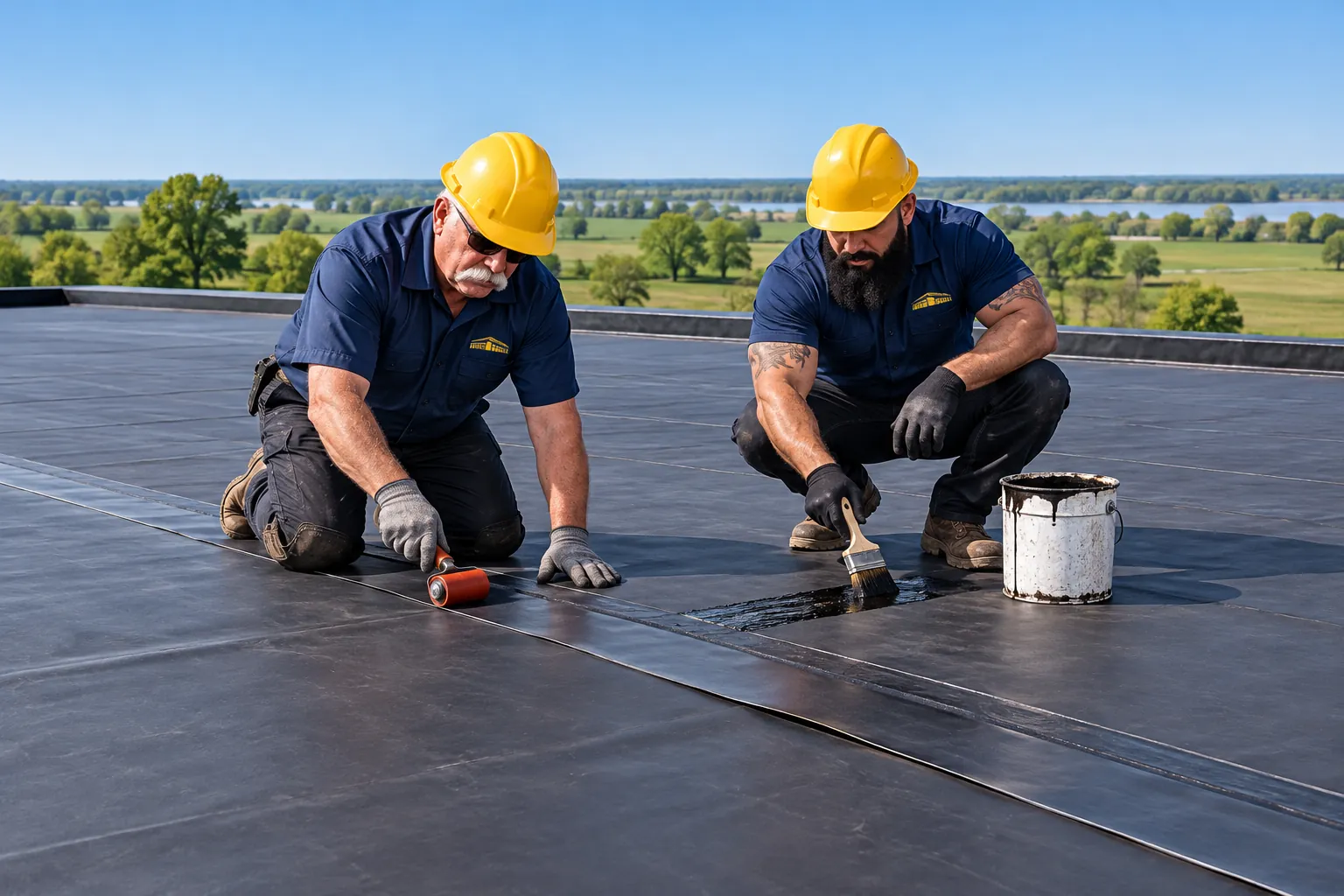
Choose a Paducah EPDM roofing contractor to install black or white rubber membrane over new insulation, with primed taped seams and molded boots at every pipe.
As a Paducah EPDM roofing contractor, we look at how the building is heated and used before pointing you to rubber.
Winter heat loss matters more than summer cooling, and traffic scuffs should stay hidden.
Cooling load drives the power bill in July, so the roof surface should reflect sun.
A moisture survey shows firm, dry boards and only one existing layer.
Kitchen fans or process vents leave oils that rubber handles poorly.
Aging EPDM shows its wear at the seams and flashings long before the open sheet gives out. The first condition is the one we see most.
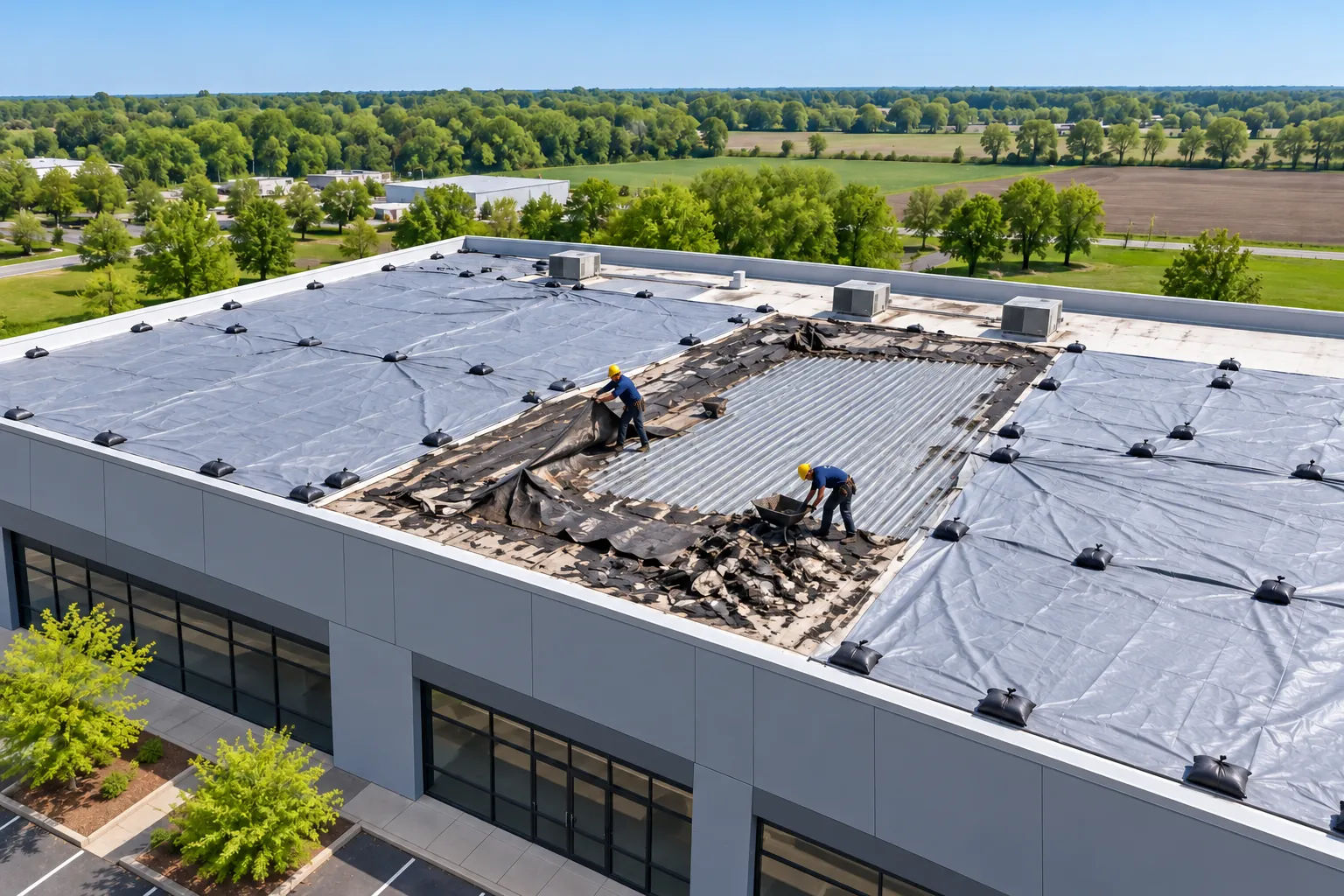
Rubber roofs from earlier decades joined their seams with liquid splice adhesive. As that glue ages, laps open at the edges and T-joints, water runs in along the seam, and the insulation underneath slowly soaks through.
Usually Means: New EPDM with taped seams, or tape repairs if the field is dry.
Membrane that shrinks pulls away from parapets and curbs, stretching flashing until it splits at the corners.
Trapped moisture lifts the sheet into soft bubbles that crack under foot traffic and hail.
Old boots crack around the pipe and the clamp loosens, opening a gap that water follows down the pipe.
Ceiling stains lined up with the seam pattern above point straight at failing laps on the roof.
Color, attachment and the flashing method are the main decisions on an EPDM job. Here is where each option fits on a commercial roof.
| Choice | Option | Where It Fits | Watch For |
|---|---|---|---|
| Color | Black | Unheated storage and shops | Warm surface on summer afternoons |
| Color | White | Air-conditioned offices and retail | Dirt near units lowers reflectance |
| Attachment | Fully adhered | Many curbs and irregular shapes | Adhesive and primer cold limits |
| Attachment | Mechanically fastened | Large steel-deck buildings | Cover strips over every fastener row |
| Attachment | Ballasted | Decks with spare load capacity | Stone weight hides damage below |
| Flashing | Molded boots and uncured rubber | Pipes and odd-shaped penetrations | Each lap must shed water downhill |
Seam tape grips slower in cold weather, so winter EPDM jobs follow the primer maker's temperature limits.
What a new rubber membrane changes on the roof, inside the building and in planning ahead.
Wide EPDM rolls cover large areas in one piece, so a warehouse roof ends up with far fewer laps than a narrow-sheet system.
Rubber stays pliable in January cold and July heat, so it handles movement at curbs and parapet walls without cracking.
Dark rubber absorbs winter sun, which helps storage buildings and shops with little heat stay a bit warmer under the roof deck.
Molded boots with stainless clamps replace cracked old flashing, ending drips down plumbing vents and conduit into the rooms below.
Black sheets cost less than white and hide scuffs, which suits budget-driven roofs where reflectance matters little.
When a moisture survey shows dry insulation, new EPDM can go over a fastened cover board instead of a full tear-off.
Call us with where the lap is lifting. A clean, primed lap with fresh seam tape can close it before water soaks the boards underneath.
Each EPDM roof goes on in the same order, from the first core cut to the last rolled seam.
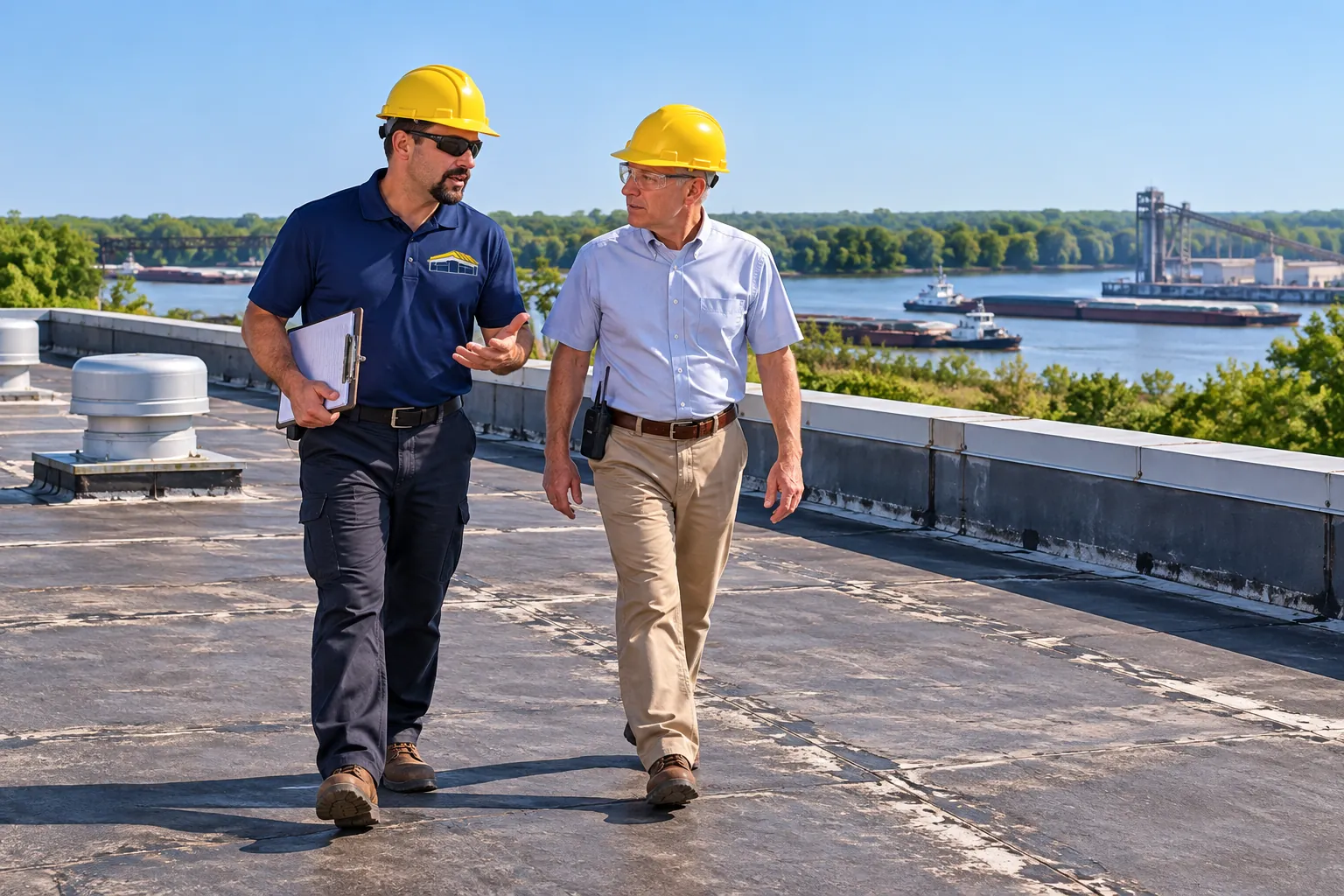
We run a moisture survey, cut cores at suspect spots, and check the deck from inside to decide between a tear-off and a recover.
Wet boards and old membrane come off where readings call for it, and recovers get blisters cut, wet areas replaced and cover board fastened down.
Wide rolls are laid out to relax, then adhered with bonding adhesive, fastened in the laps, or held with ballast where the deck allows.
Laps are scrubbed with primer, seam tape is set and rolled across its full width, and lap sealant runs along exposed edges and T-joints.
Curbs get membrane run up under counterflashing, pipes get molded boots with clamps, and drains get the sheet set under the clamping ring.
Some buildings call for a different membrane or extra drainage work alongside the rubber.
Air-conditioned floors under the roof lean toward white TPO, whose welded seams suit roofs with heavy summer cooling load.
TPO roofing in PaducahRings of standing water around drains need tapered insulation and crickets before any new rubber goes down.
Flat roofing in PaducahPlant roofs with oil-bearing exhaust need a membrane checked against the maker's chemical chart, which often rules rubber out.
Industrial roofing in PaducahRubber roof questions owners bring up most, from EPDM rubber roof seams in Paducah to color and flashing, each with a short answer shown first.
EPDM is a synthetic rubber membrane laid in large sheets over insulation, and it bends without cracking in summer heat or winter cold. Warehouses, schools, offices and churches with low-slope roofs carry it. You can spot one by its dark rubber surface, primer edges along the seams, rubber pipe boots and metal counterflashing at parapet walls.
Today's EPDM seams use seam tape pressed into laps that have been scrubbed with primer, then rolled across the full tape width. Exposed edges and T-joints get lap sealant, and fastener rows get cover strips. Older roofs used liquid splice adhesive instead, which is why their glued laps are often the first thing to open.
It comes down to whether the building fights summer cooling or winter heat loss. Offices and stores with air conditioning lean white, since the reflective top layer keeps sun heat off the roof. Unconditioned storage often stays black, which costs less and hides scuffs. White sheets need washing near units and foot paths to keep reflecting.
Yes, as long as the old insulation is dry and the deck is firm, which a moisture survey confirms first. Old blisters are cut flat, wet areas are replaced, cover board is fastened, and new rubber goes over it. The added layers raise the roof edge, so edge metal, curb flashing and scuppers are rebuilt higher.
Each detail gets its own method. Curbs take membrane run up under metal counterflashing, round pipes get molded boots with stainless clamps, and odd shapes get uncured rubber formed by hand or a pitch pan. At drains the sheet sits under the clamping ring with sealant, lapped so water flows over each joint.
Tell us the roof size, how the building is heated and where leaks show up. We will walk the roof and send a free estimate for new EPDM.
Want A Call About Your Roof?
Leave your name and number and we will call you back about the roof.
Or call now: (618) 386-4443